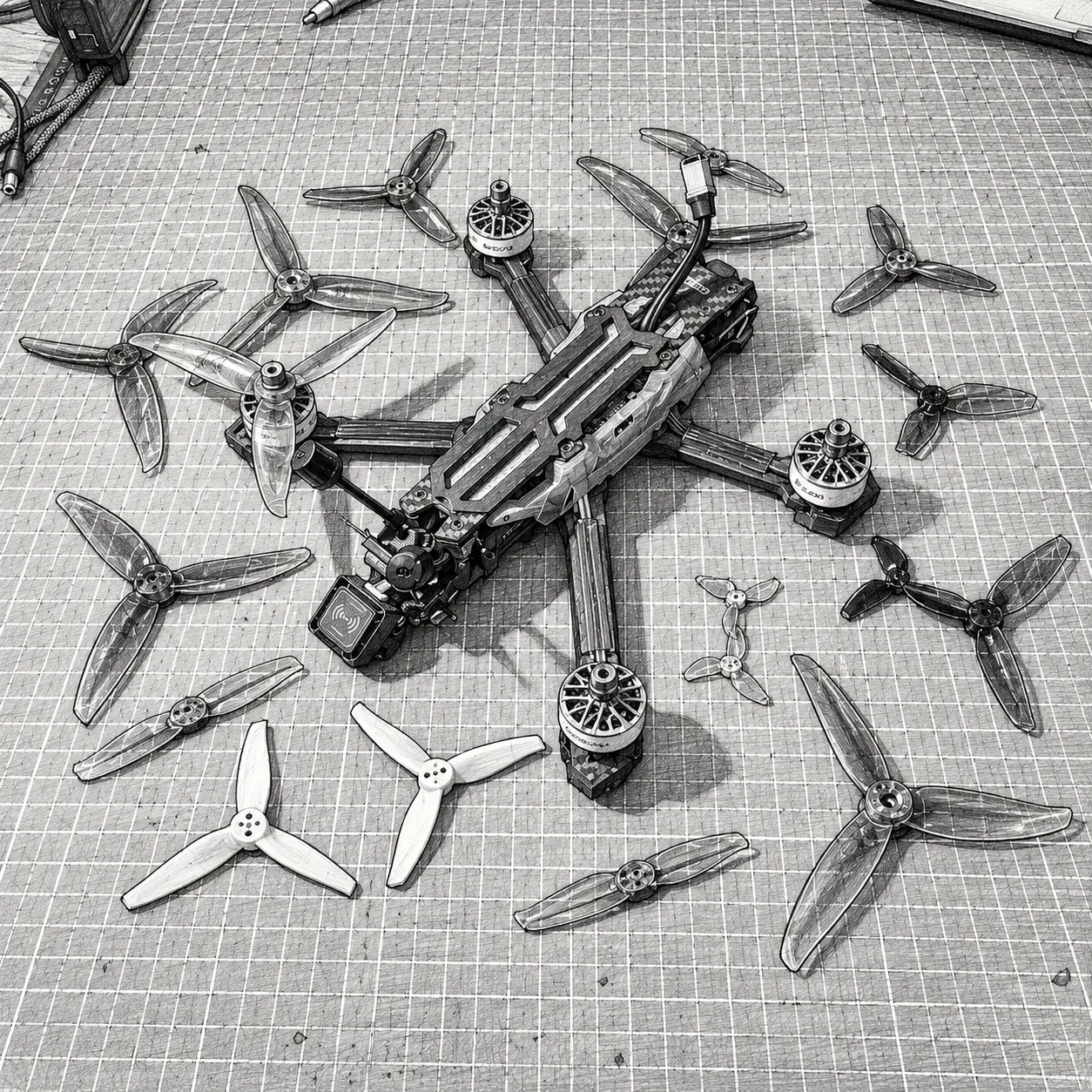
FPV propellers are some of the simplest and cheapest parts of an FPV drone. There’s no electronics to configure, no firmware to update, and when you break a prop, you usually just replace it with a new one. But a propeller’s low price doesn’t mean it isn’t important. Propellers convert the motors’ rotational energy into thrust and ultimately keep the drone in the air.
Turinys
- What is a propeller and what does it do?
- How do you read a propeller name?
- Propeller diameter
- Propeller pitch
- Propeller shape
- Propeller material
- Propeller rotation direction
- How is a propeller mounted to the motor?
- Propeller + motor + battery
- How to choose an FPV propeller
- How can you tell if a propeller isn’t right for your drone?
- When should you replace a propeller?
- Common FPV propeller mistakes
What is a propeller and what does it do?
A propeller consists of several blades arranged around a central axis and driven by the drone’s motor. At first glance, a propeller might look like a simple piece of plastic, but each blade is essentially a small airfoil — much like an airplane wing, except that instead of moving straight forward, it rotates around the motor shaft.
How does a propeller generate thrust?
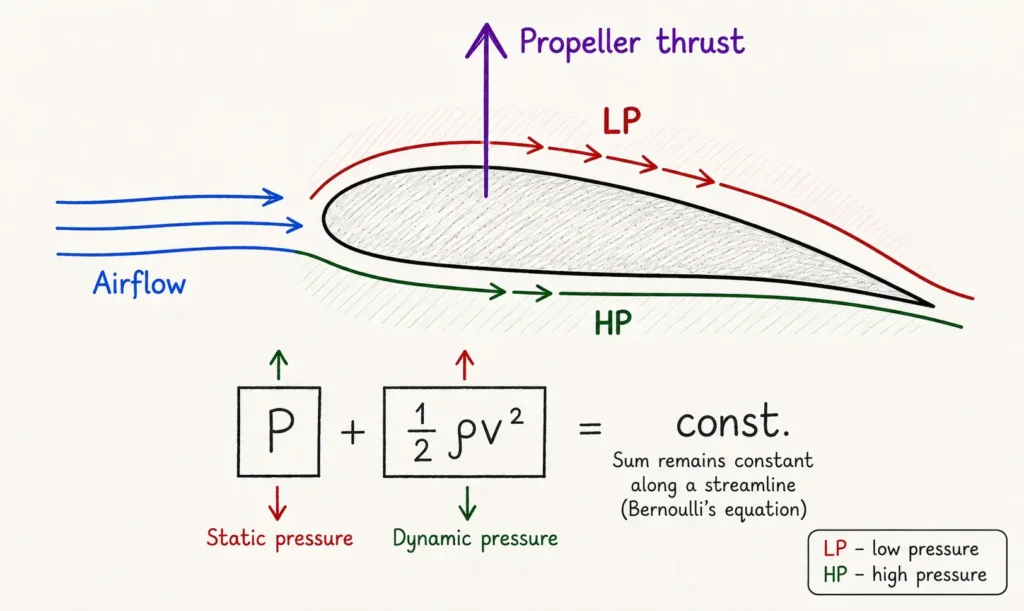
Where does the force that lifts the blade come from? As the airflow reaches the blade’s leading edge, it splits and flows over and under the blade. Because of the blade’s airfoil shape and its orientation relative to the airflow, the airspeed and pressure are distributed differently around the blade. When the propeller generates thrust, the airflow over one side of the blade generally moves faster than over the other, creating a pressure difference across the blade.
In a simplified case, Bernoulli’s equation, which describes the conservation of energy in fluid flow, states that the sum of static and dynamic pressure remains constant along a streamline. Where the airspeed v is higher, the dynamic pressure is also higher, so the static pressure is lower.
This creates a low-pressure region (LP) above the blade. Below the blade, the airspeed is lower and the static pressure is higher, creating a high-pressure region (HP).
Pressure acts on both sides of the blade, but the higher pressure underneath pushes it upward more strongly than the lower pressure above pushes it downward. This pressure difference creates an aerodynamic force on the blade that, in a rotating propeller, contributes to propeller thrust.
Buuut… there’s another explanation
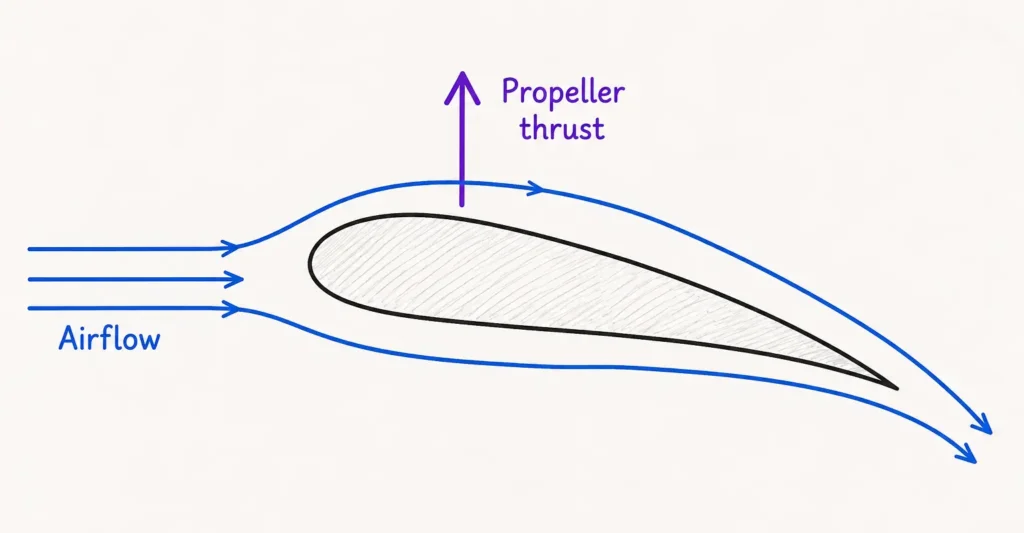
Buuut… the first explanation still leaves one important question unanswered: why does this particular distribution of airspeed and pressure form around the blade in the first place? There’s another way to look at the same process — by focusing on what happens to the airflow. Even a blade with a symmetrical airfoil can generate thrust. If that airfoil moves through the air at a certain angle, the flow around it is no longer symmetrical.
Just like in the first explanation, the airflow splits when it reaches the propeller blade’s leading edge. Some of it flows over the blade and some underneath it. By the time the two streams reach the trailing edge, they have been deflected downward.
The blade changes the pressure and velocity field of the air flowing around it, causing the airflow behind the blade to be deflected downward. At the same time, an aerodynamic force acts on the blade in the opposite direction — this is propeller thrust.
If you’re interested in a more precise and detailed explanation, I recommend watching this video by aerothermal engineering specialist Chris Rosser. The first 9 minutes cover exactly this:
Now that we know how propellers — or props, as they’re commonly called — keep a drone in the air, we can head over to an online store and order some. Almost. Before we do that, let’s figure out what all the information in those propeller listings actually means.
How do you read a propeller name?
At first glance, FPV propeller names can look like a fairly meaningless jumble of numbers and letters — for example, 5×4.3×3 or 51466. Most of these markings describe the propeller’s basic specifications: its diameter, pitch, and sometimes the number of blades. The only problem is that different manufacturers write this information in slightly different ways.
One of the clearest naming formats is 5×4.3×3 — this is how most HQProp propellers are labeled, for example. The first number, 5, indicates the propeller diameter in inches. The 4.3 is the propeller pitch, also measured in inches. The final 3 means that the propeller has three blades. So, 5×4.3×3 describes a three-blade propeller with a 5-inch diameter and a 4.3-inch pitch.
Another fairly common format is a more compact one. For example, Gemfan 5155 can be broken down into 51 / 55: approximately a 5.1-inch diameter and a 5.5-inch pitch.
Unfortunately, you shouldn’t rely on the name alone when choosing a propeller with a specific diameter or pitch. For example, some propellers from Gemfan don’t follow this naming convention. While trying to figure out why, I came across a Joshua Bardwell video in which a Gemfan representative explains that these are historical “mistakes.”
So, to avoid getting caught out, it’s worth checking the propeller’s product description as well — preferably on the manufacturer’s website rather than the retailer’s, because not every retailer knows about this little Gemfan “quirk.” The manufacturer’s website may also list recommended motor sizes for the propeller.
Propeller diameter
Propeller diameter is measured in inches — for example, 2”, 3”, 5”, 7”, or 10”. It is the distance from the tip of one propeller blade to the tip of the opposite blade, measured through the center. FPV drone size is also commonly described by the diameter of the propellers it uses. For example, when we talk about a “5-inch drone,” we usually mean a drone designed for roughly 5-inch propellers.
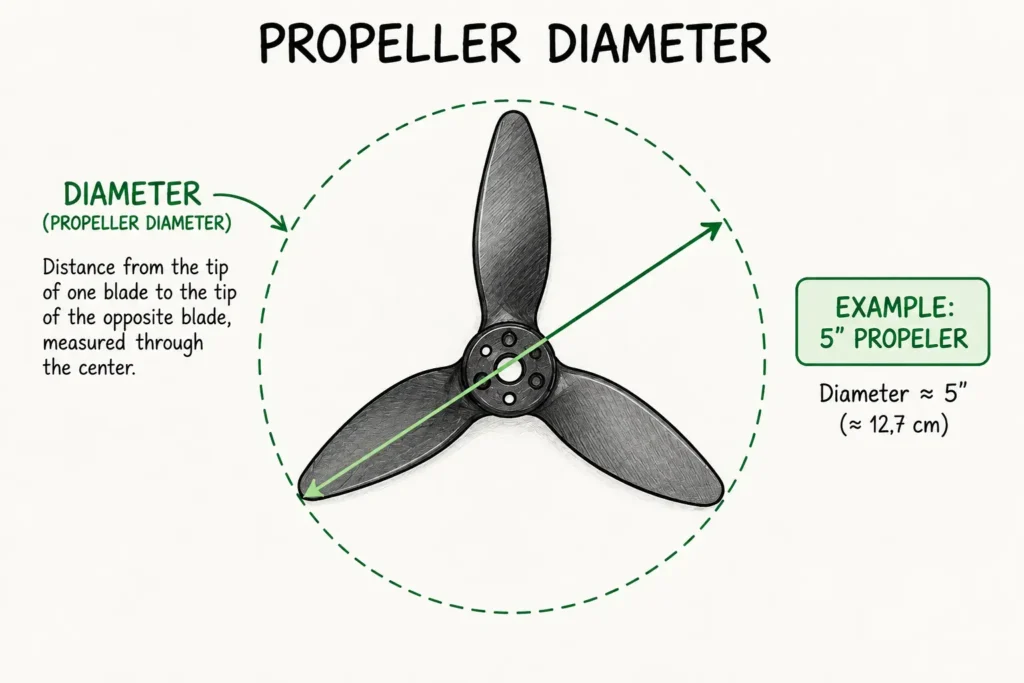
As propeller diameter increases, so does the area of air the propeller acts on. This allows a larger propeller to generate the required thrust more efficiently when the entire propulsion system is properly matched. That’s one reason larger propellers are commonly used on long range drones, where efficient flight is particularly important.
However, a larger propeller is also harder to accelerate and decelerate. It puts more load on the motor, and its RPM is generally harder to change quickly. Smaller and lighter propellers can change RPM more quickly, so a well-matched drone with smaller props can respond very quickly to pilot inputs.
Propeller diameter can’t be chosen independently of the other components. The propeller has to physically fit the frame, and the motor has to be suitable for a propeller of that size. So you can’t simply put 7-inch props on a 5-inch drone and expect more thrust — the propeller, motor, and frame sizes all have to work together.
Propeller pitch
Another important propeller specification is its pitch, which is also measured in inches. In theory, pitch describes how far a propeller would move forward during one complete revolution in an ideal medium with no slip — similar to the way a screw advances into a material. In real air, the propeller doesn’t actually move that far because of slip and other aerodynamic effects.
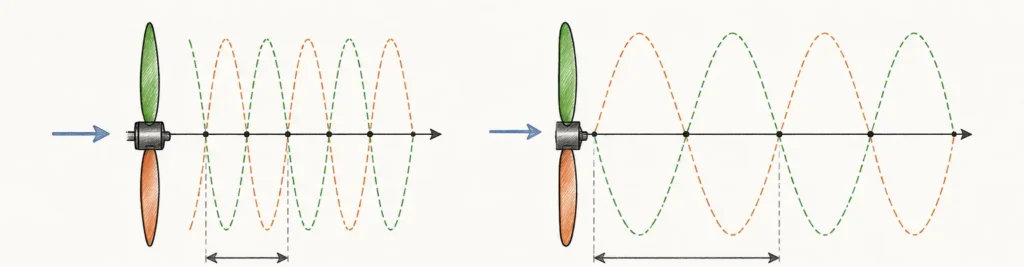
In the image above, the propeller on the left has a lower pitch, so in one complete revolution it would theoretically travel a shorter distance. The propeller on the right has a higher pitch, so it would theoretically travel farther.
When it comes to thrust, at the same RPM and with otherwise similar propeller geometry, a higher pitch generally increases blade loading and can allow the propeller to generate more thrust.
For example, compare two similarly designed 5×3.5 and 5×4.5 propellers. Both have a 5-inch diameter, but their pitch is different. The blades of the 3.5-inch-pitch propeller are less steeply angled than those of the 4.5-inch-pitch propeller.
A lower-pitch propeller generally puts less load on the motor and, under certain conditions, requires less power. It can also provide a smoother, more controllable flight. A higher-pitch propeller can generate more thrust at the same RPM and allows for a higher theoretical speed, but it also generally increases the load on the motors and ESC.
So a higher pitch doesn’t automatically mean a faster drone. An overly aggressive propeller can put so much load on the motor that it can no longer reach the same RPM, while current draw and motor temperature increase. Choosing the right pitch is a compromise between the thrust, speed, responsiveness, and efficiency you want.
Propeller shape
The same propeller diameter, pitch, and number of blades doesn’t necessarily mean that two propellers are identical. Blade width, shape, thickness, tip geometry, and overall propeller weight can all differ. All of these factors affect the propeller’s aerodynamic characteristics, the load it puts on the motor, and ultimately how the drone feels in the air.
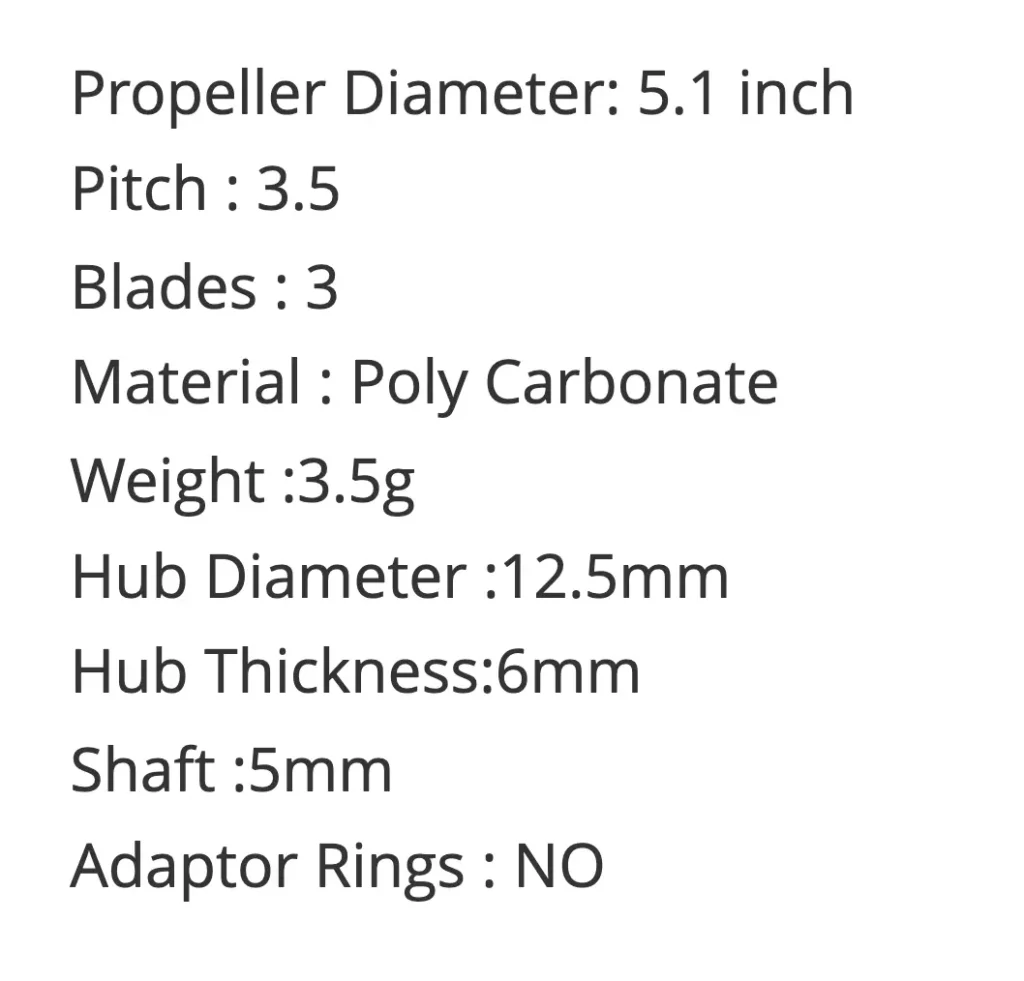
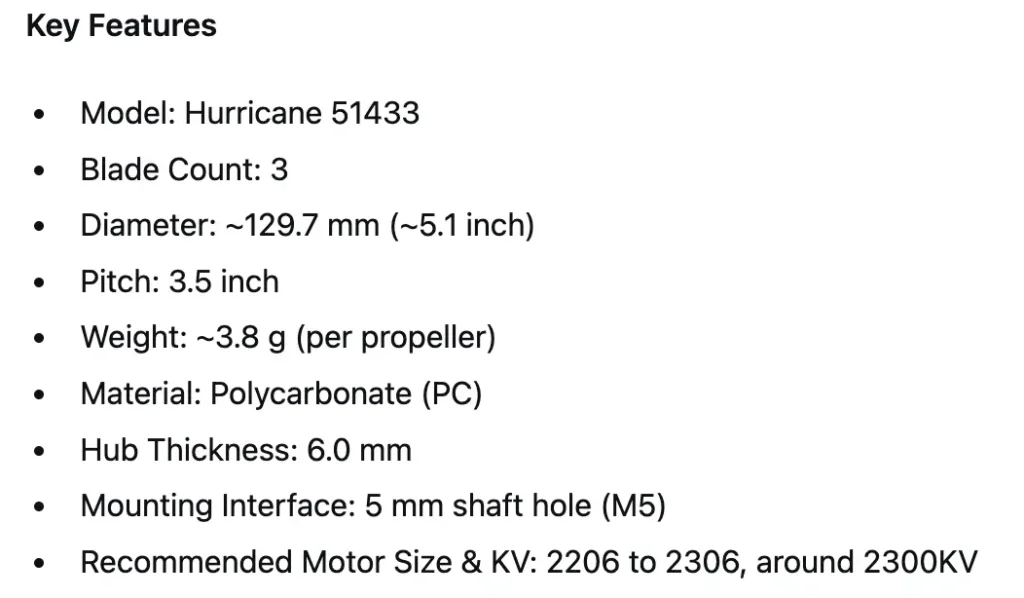
A good example is the HQProp Ethix P3.5 and Gemfan Hurricane 51433. Both are roughly 5.1-inch, 3.5-inch-pitch, three-blade polycarbonate propellers, but when you look at them from above, the difference is obvious. The Ethix P3.5 has “fuller” blades, while the Hurricane 51433 has more swept-back blades that taper more noticeably toward the tips.
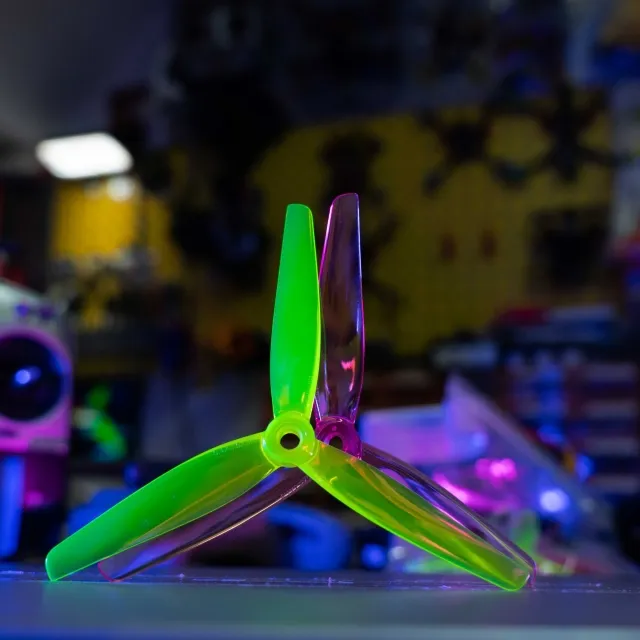
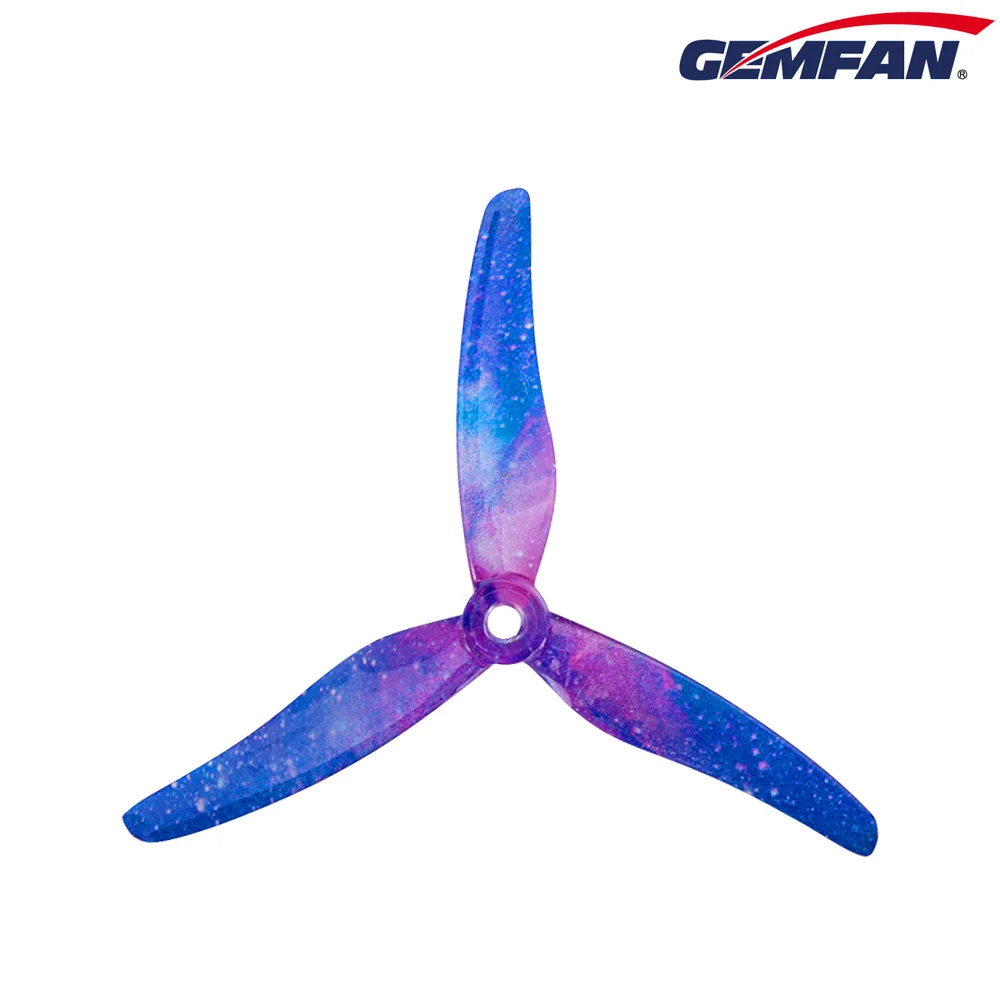
Blade area also has a significant effect on a propeller’s characteristics. A blade with a larger surface area can act on the air more aggressively and generate more thrust, but it also generally puts more load on the motor. Narrower blades can be lighter and more efficient, but again, you can’t judge a propeller’s overall characteristics by blade width alone — the geometry of the entire blade matters.
Propeller weight matters too. In this example, the HQProp weighs 3.5 g, while the Gemfan weighs 3.8 g — a difference of about 9%. A motor can accelerate and slow down a lighter propeller more easily, allowing its RPM to change more quickly. A heavier propeller has greater rotational inertia, so it responds more slowly to changes in motor RPM.
That’s why markings such as 5.1×3.5×3 describe only a propeller’s basic specifications. Even propellers with the same diameter, pitch, and number of blades can differ in thrust, motor load, efficiency, and responsiveness because of differences in blade geometry and weight.
Propeller material
One of the most common materials used for FPV drone propellers is polycarbonate (PC). Polycarbonate is relatively stiff, while still being flexible and impact-resistant. When a PC propeller hits a branch, the ground, or another obstacle, it will often bend or deform before it breaks completely. That makes polycarbonate particularly practical for freestyle and other FPV drones where crashes are hardly a rare occurrence.
However, propeller blades are subjected to significant aerodynamic and centrifugal loads during flight. A blade that is too flexible can deform, slightly changing its shape and angle at high RPM. That’s why some propellers use fiber-reinforced plastics, such as glass-fiber- or carbon-fiber-reinforced polyamide (nylon). Adding fibers to the plastic generally increases its stiffness and can improve its mechanical strength, so the blade bends and twists less and maintains its intended geometry better under high loads. On the other hand, greater stiffness doesn’t necessarily mean better crash resistance — a more flexible blade can absorb some of the impact by deforming.
A good example of these different materials is the Gemfan Cinelifter 7037. Gemfan offers the same size propeller in polycarbonate, glass-fiber-reinforced nylon, and carbon-fiber-reinforced nylon. These stiffer materials are particularly relevant for larger propellers and cinelifters — drones specifically designed to carry heavier professional camera equipment — because their blades are subjected to greater loads.
Once again, propeller material — like many other propeller characteristics — is a compromise. A more flexible propeller may handle impacts better, while a stiffer one can deform less under load and maintain its intended blade geometry more effectively. So when choosing a propeller, it’s worth looking not only at its diameter, pitch, and number of blades, but also at the material it’s made from — rather than simply picking any prop of the right size from an online store.
Propeller rotation direction
Most of the propeller specifications we’ve discussed so far — diameter, pitch, number of blades, shape, and material — would usually still allow the drone to fly even if they weren’t chosen optimally. It might be inefficient or sluggish, the motors might run hot, or it might simply fly poorly. But when it comes to propeller rotation direction, there’s much less room for error. Install a propeller designed for the wrong direction and the drone may not take off at all — and that would actually be the better outcome. In a worse case, it could flip over violently as you try to take off and break or at least damage something.
FPV drone propellers are made for two rotation directions. A CW (clockwise) propeller is designed to rotate clockwise, while a CCW (counterclockwise) propeller is designed to rotate counterclockwise. These aren’t simply identical propellers that can be spun in either direction — CW and CCW propellers have mirrored blade geometry. If a propeller spins in the wrong direction, it will push air upward instead of downward, so it won’t generate thrust in the direction needed to lift the drone.
So how can you tell a CW propeller from a CCW propeller? Start by looking at the blade’s leading edge and trailing edge. The leading edge is usually thicker and more rounded, while the trailing edge is thinner and sharper. As the propeller rotates, the leading edge should be the part of the blade that “cuts” through the air first. So, when looking at the propeller from above, you can use the leading edge to determine which way it’s designed to rotate — clockwise (CW) or counterclockwise (CCW).
The leading edge also sits higher than the trailing edge. You can use this to determine which side of the propeller should face up and which should face down.
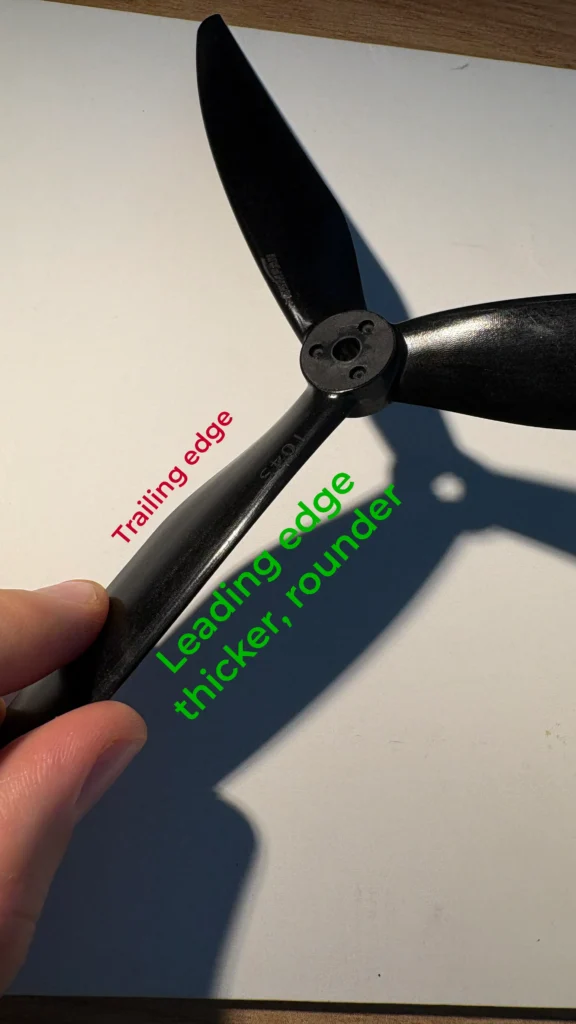
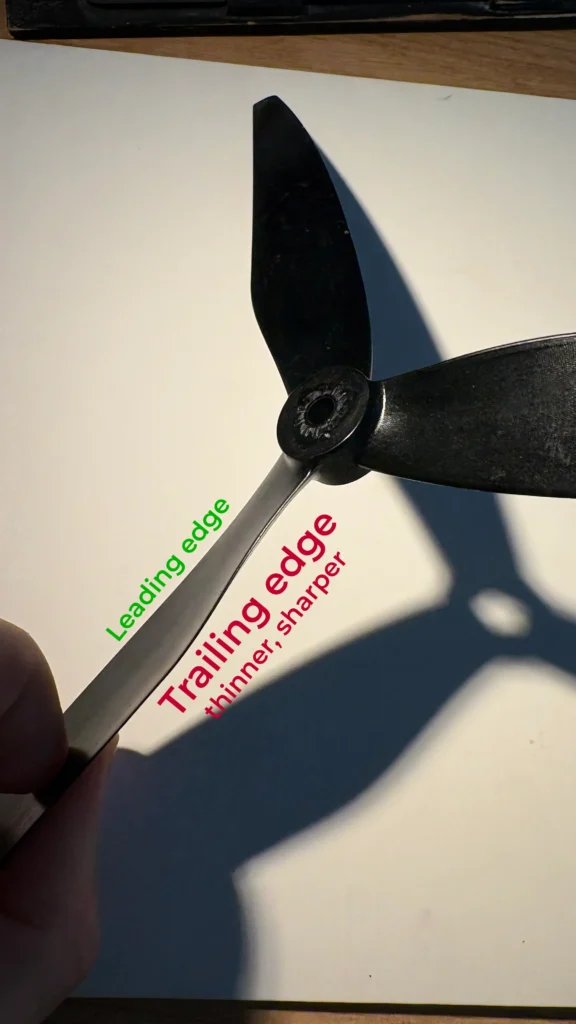
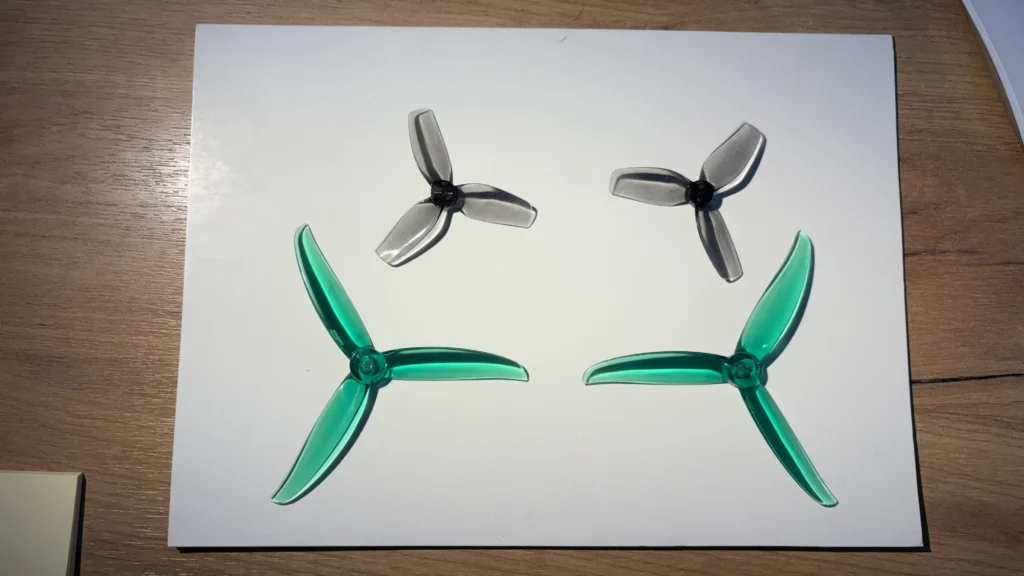
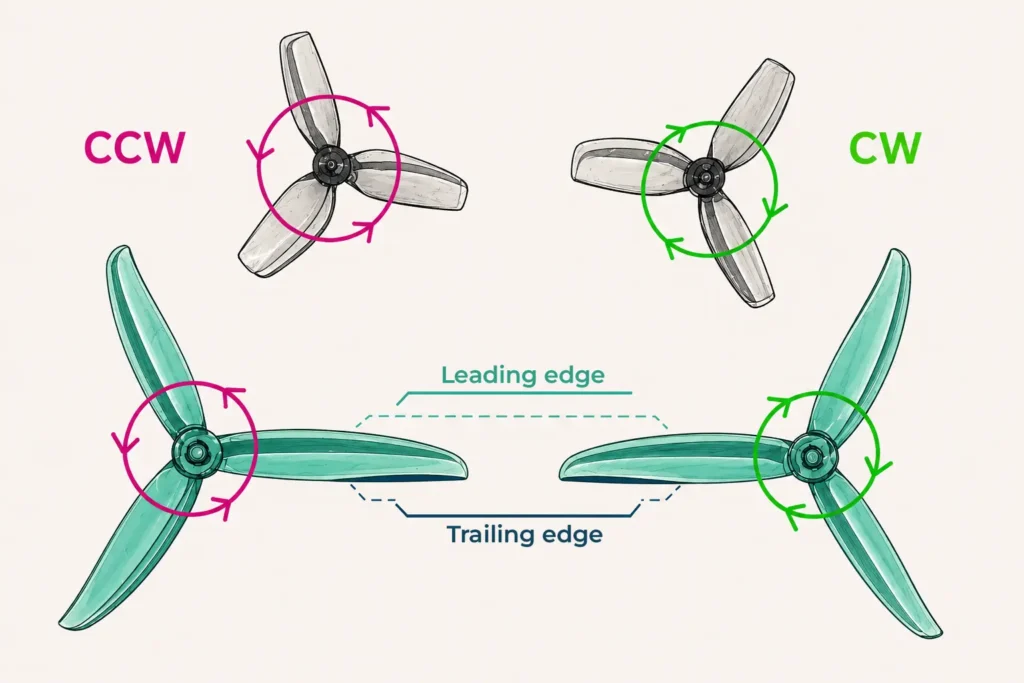
Some manufacturers also mark the rotation direction directly on the propeller. For example, you may come across an R (reverse) marking. However, these markings aren’t completely standardized between manufacturers, so you shouldn’t rely on them blindly. Identifying the leading and trailing edges is a more universal way to determine the correct rotation direction.
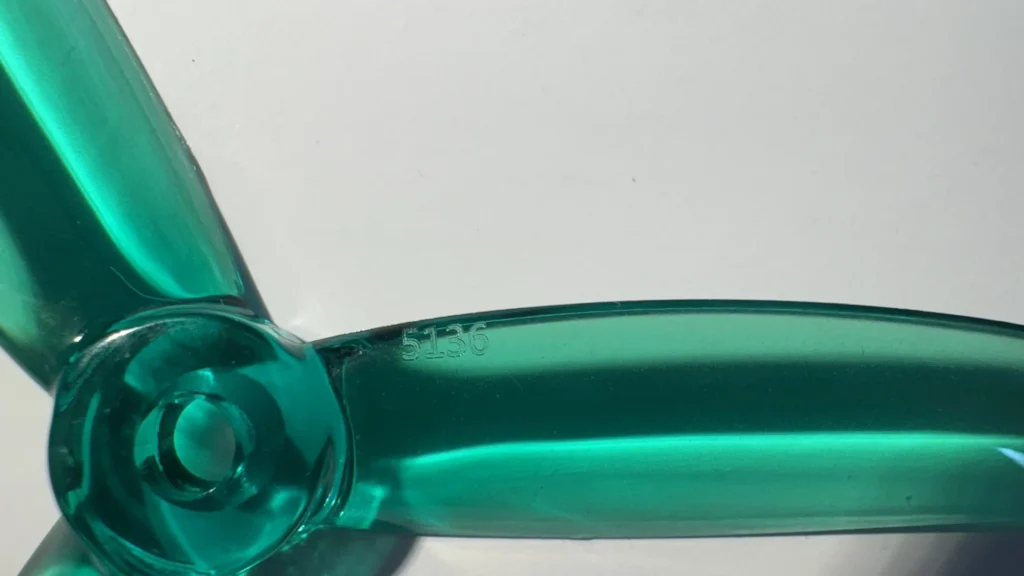
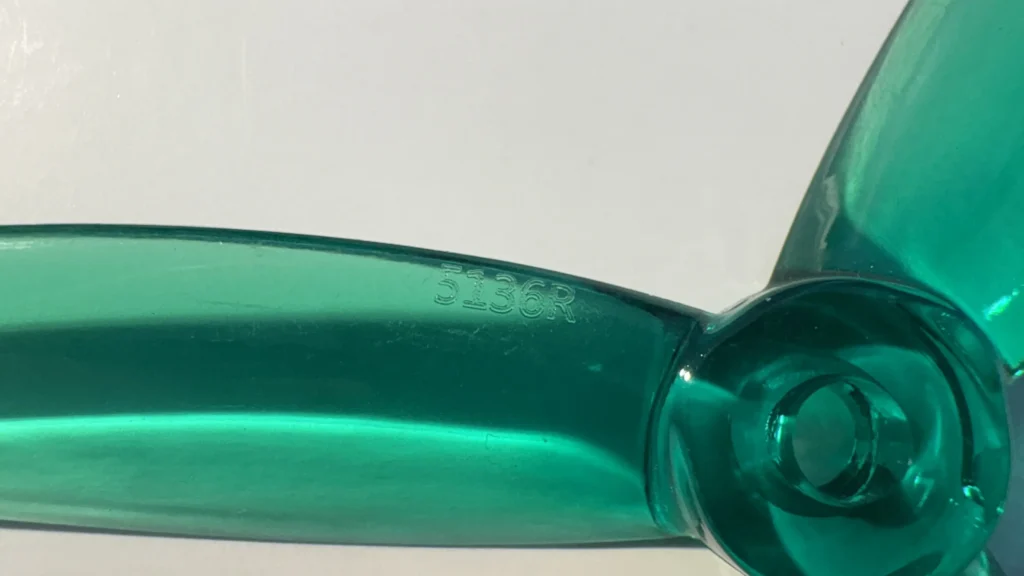
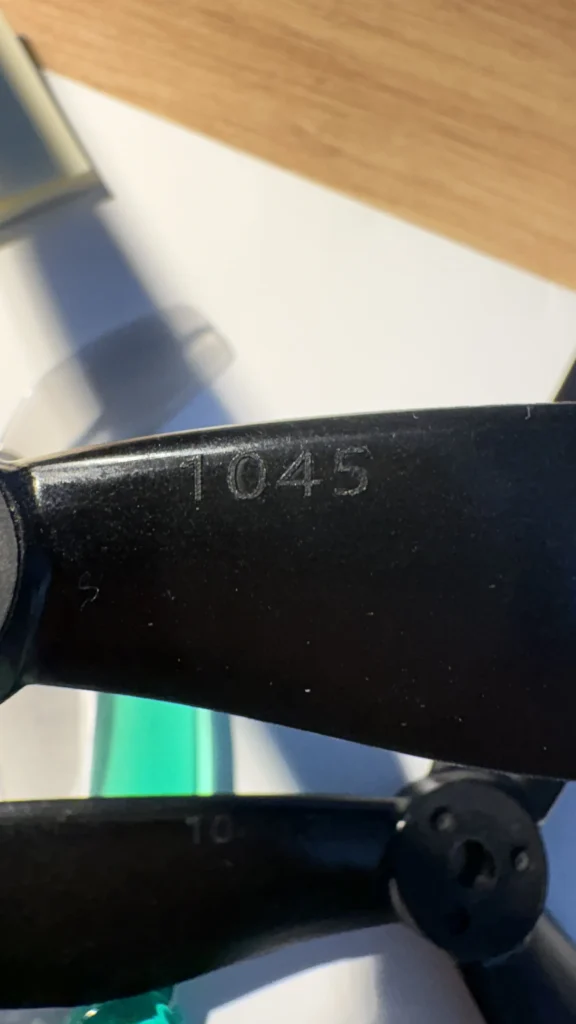
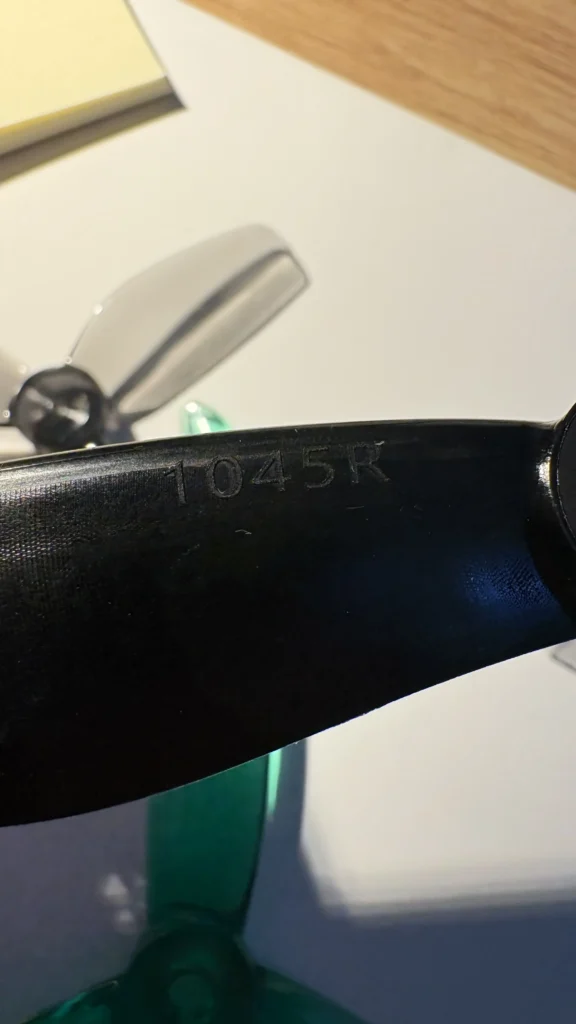
On a typical four-motor FPV drone, two motors and propellers rotate CW while the other two rotate CCW. This balances the reaction torque. When a motor spins a propeller in one direction, an opposing torque acts on the drone’s frame. If all four propellers rotated in the same direction, these torques would add together and cause the entire drone to rotate in the opposite direction around its vertical — or yaw — axis. With two propellers rotating CW and two CCW, their reaction torques largely cancel each other out during normal flight.
Props in and props out
Although two propellers need to rotate CW and two CCW, there are two commonly used ways to arrange them.
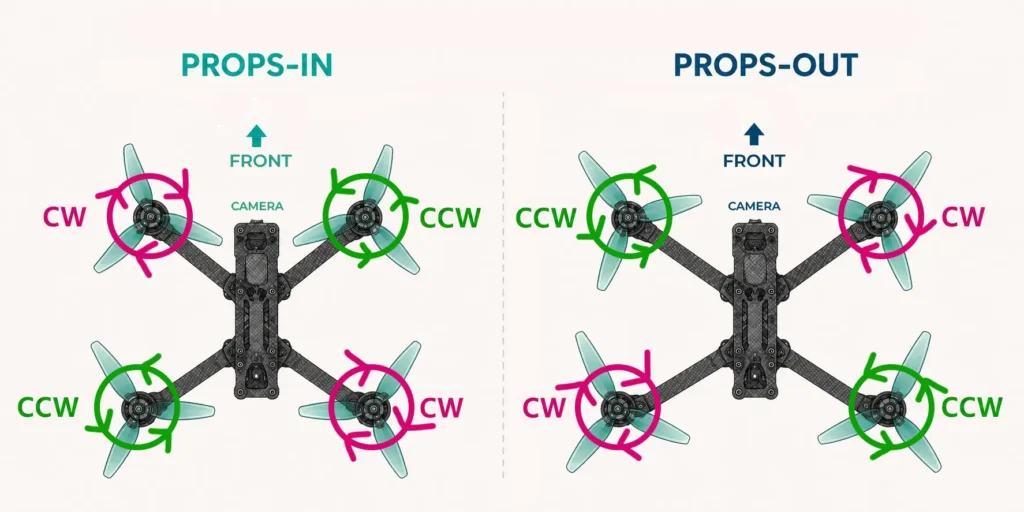
In a Props In configuration, when looking at the drone from above, the front propeller blades move toward the center of the drone as they pass closest to the centerline. This is the traditional Betaflight propeller rotation configuration.
In a Props Out configuration, it’s the opposite — the front propeller blades move away from the center as they pass closest to the drone’s centerline. In Betaflight, this configuration is selected using the Motor direction is reversed setting. Props Out is fairly common on FPV drones because the front propellers tend to throw grass, sand, and other debris away from the center of the drone and the camera rather than toward them. Of course, if there’s no protection on the sides, that same debris can instead be thrown toward the drone’s main components.
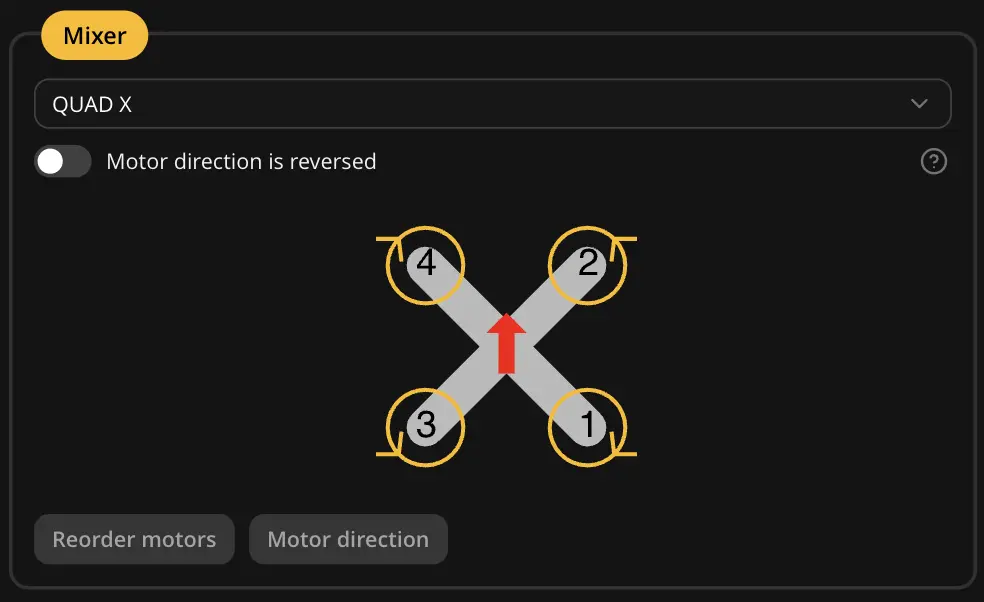
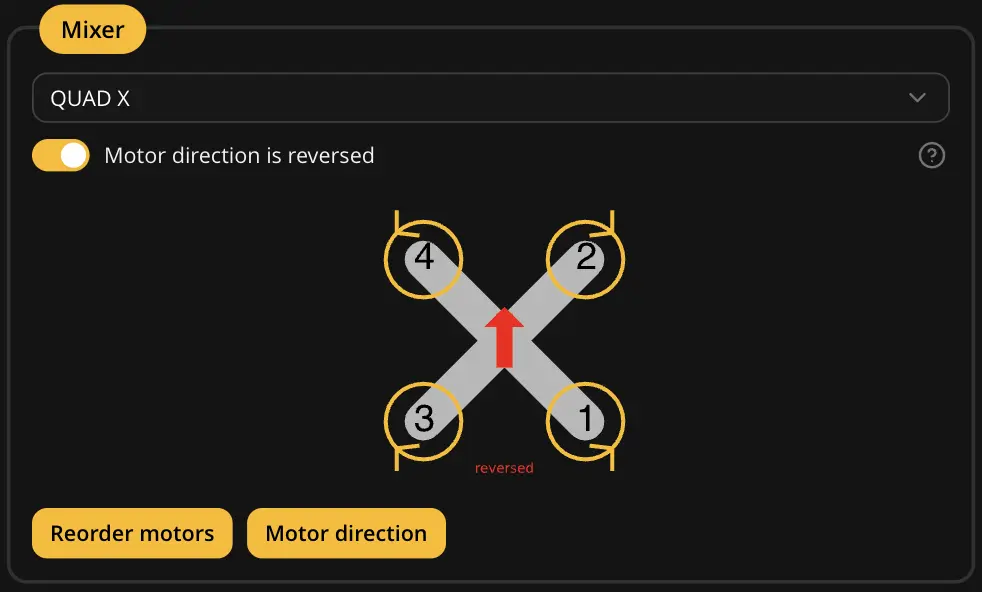
In both cases, the drone still uses two CW and two CCW propellers — only their positions change. Neither Props In nor Props Out is inherently the “correct” configuration.
So simply buying the correct CW and CCW propellers isn’t enough. For the drone to take off and fly properly, three things have to match:
- The propellers must be installed correctly — CW propellers on motors rotating CW, and CCW propellers on motors rotating CCW.
- The motors must physically rotate in the correct directions for the selected Props In or Props Out configuration.
- The Betaflight configuration must match the actual motor rotation layout — Props In or Props Out (Motor direction is reversed).
When buying propellers, it’s also worth checking what’s actually included in the package. FPV drone propellers are often sold in sets of four — 2 CW + 2 CCW — but that isn’t always the case. So in addition to checking the propeller diameter, pitch, and number of blades, check how many propellers are included and which rotation directions you’re actually getting.
How is a propeller mounted to the motor?
Even if a propeller’s diameter, pitch, and other specifications are a perfect match for your drone, there’s still one rather basic question left — will it actually fit on the motor? FPV propellers and motors use several different mounting standards, so two propellers of the same size aren’t necessarily interchangeable.
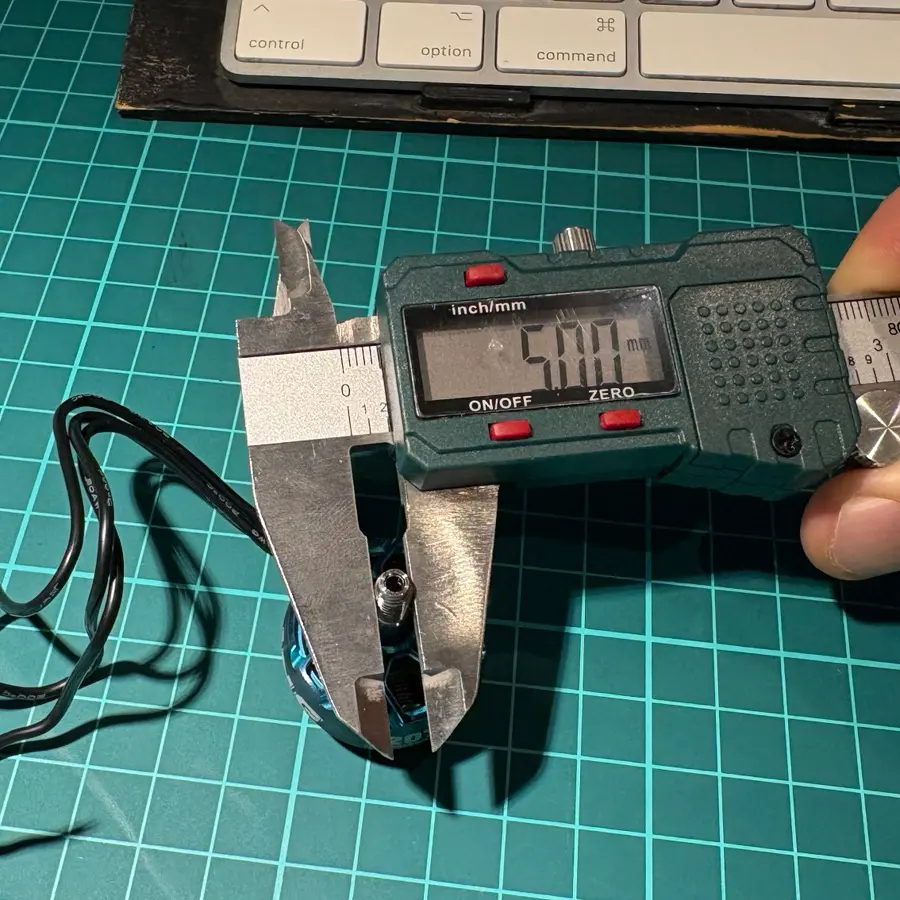
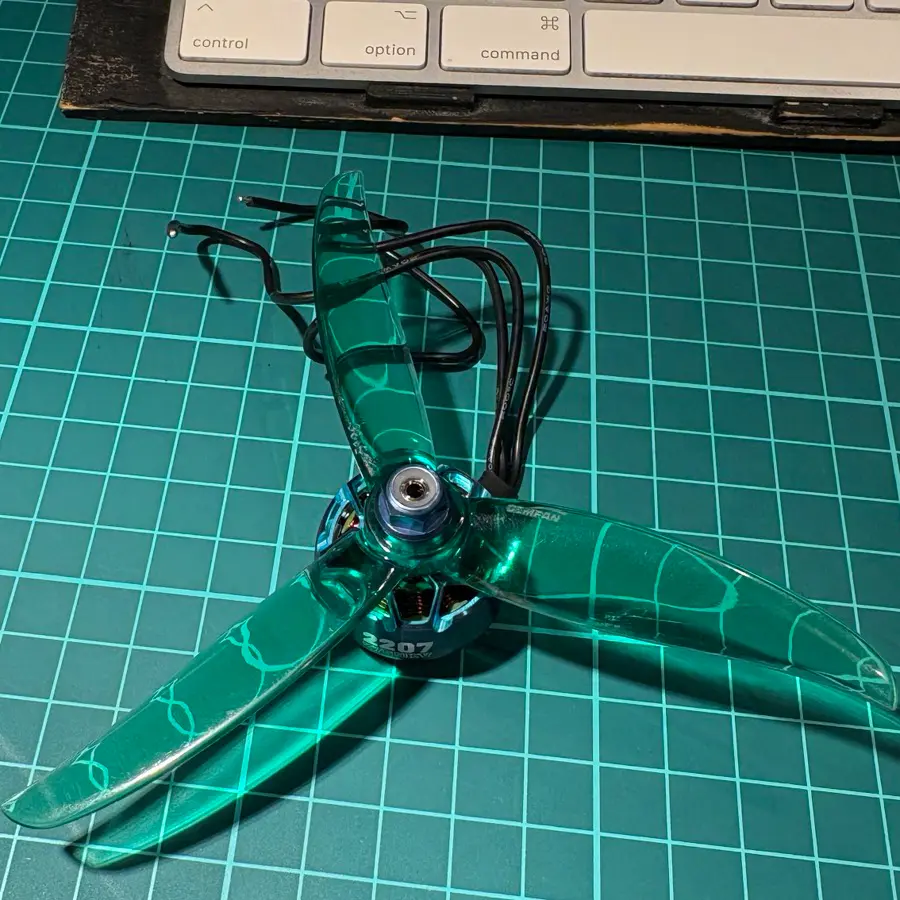
The most common mounting method on 5-inch and similarly sized FPV drones is a 5 mm shaft. The motor shaft passes through the 5 mm hole in the center of the propeller, and the propeller is secured from above with a nut. It’s a simple and robust solution, which is why it’s widely used on freestyle and racing drones.
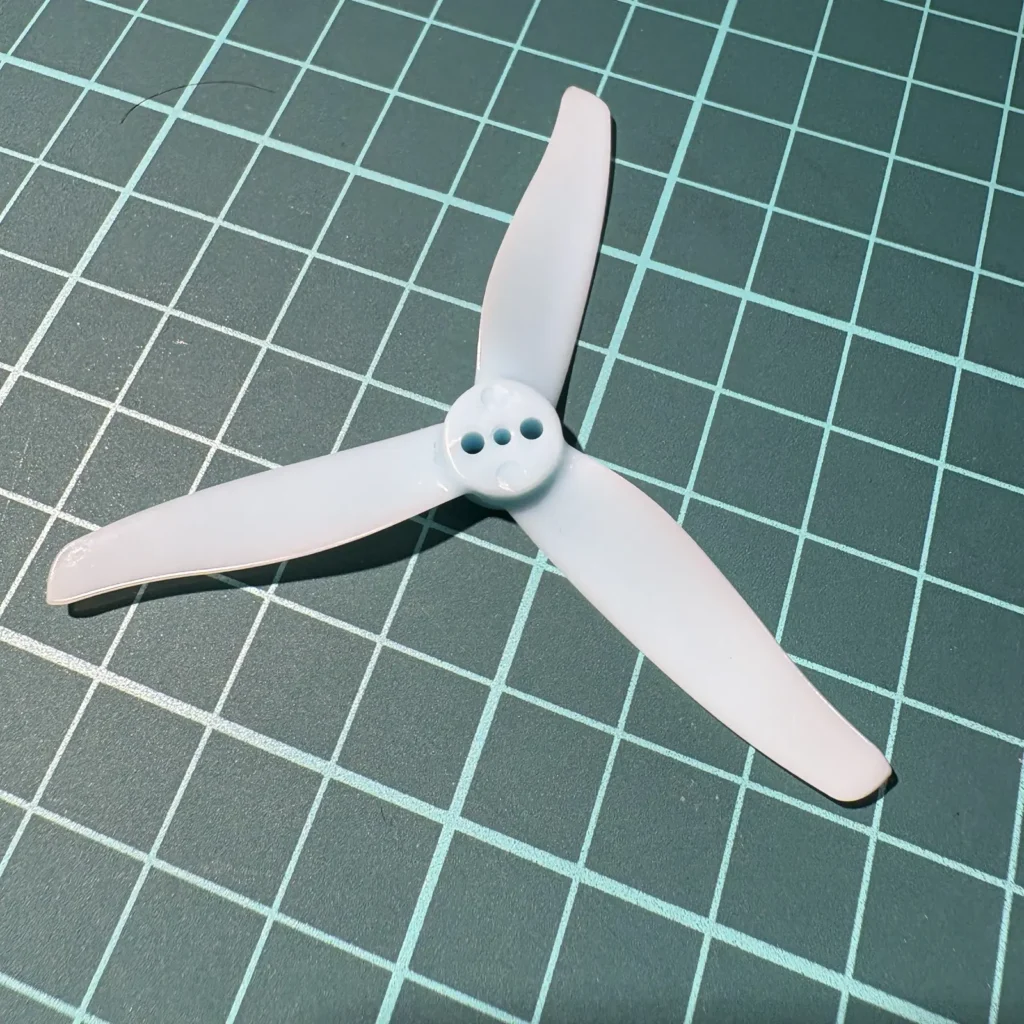
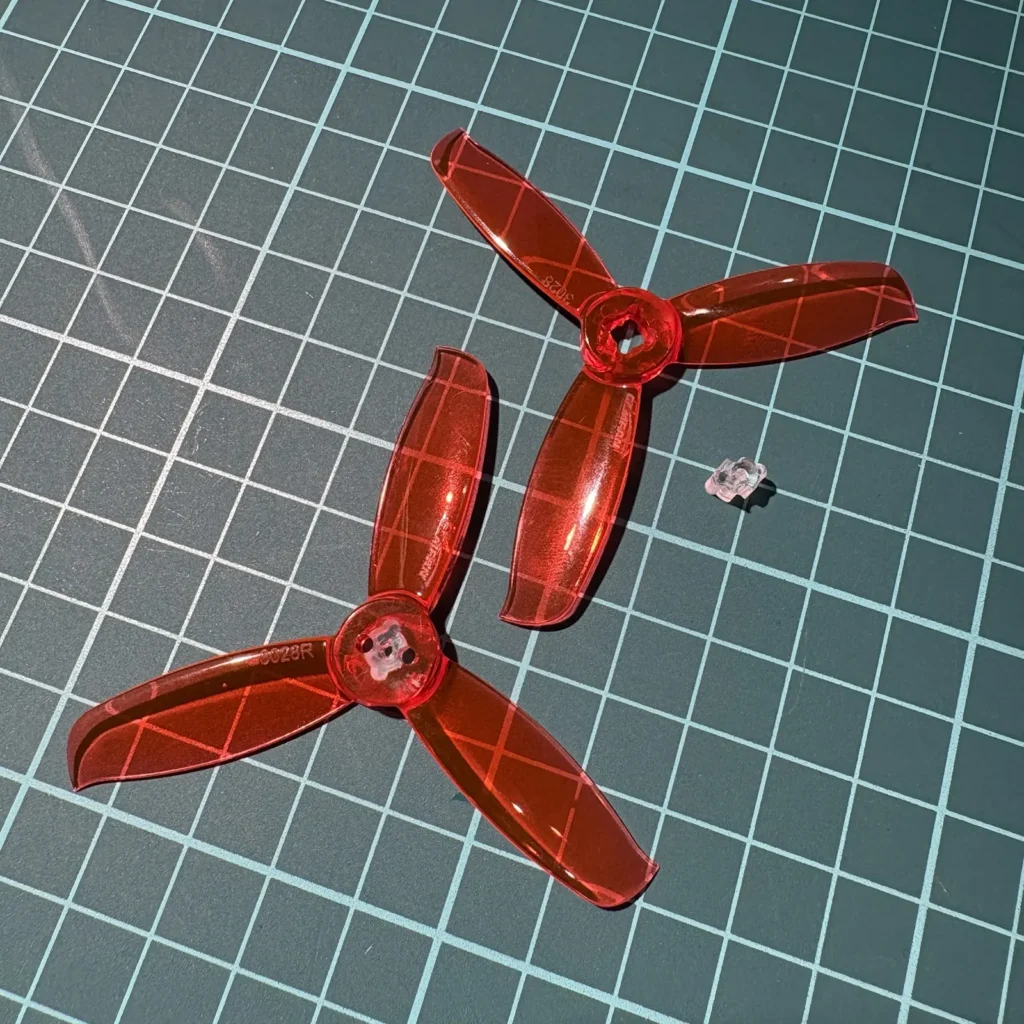
Smaller FPV drones often use a T-mount. Instead of one large 5 mm hole, the center of the propeller has a smaller shaft hole and two additional holes for screws. The propeller slides onto the motor shaft and is secured to the motor bell with two screws. T-mounts are especially common on smaller, lighter drones. You can also find propellers designed to work with both mounting systems. For example, some Gemfan propellers have both a 5 mm center hole and screw holes for a T-mount, with an adapter included with the propellers.
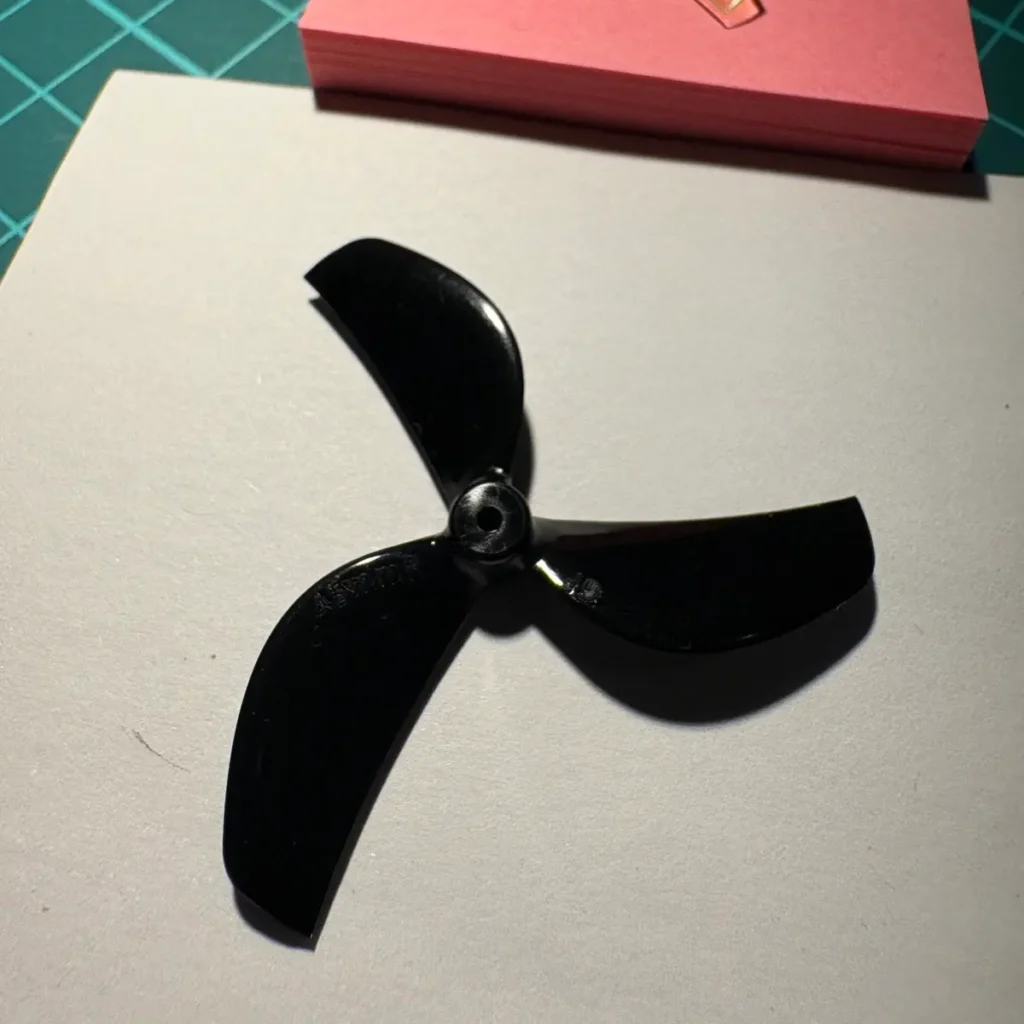
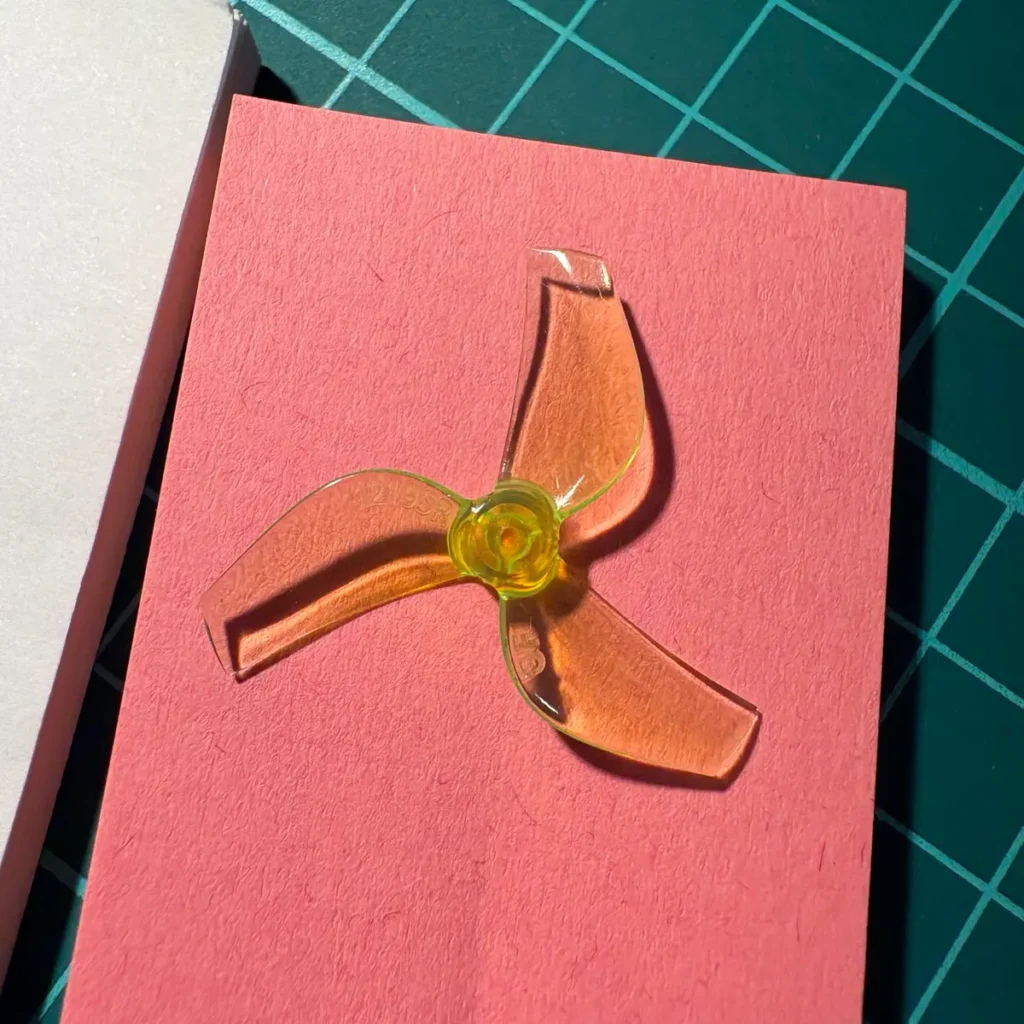
Even smaller tinywhoop and toothpick drones often use a press-fit mounting system. This is even simpler — the propeller is simply pressed onto the motor shaft, with no nut or screws holding it in place. These motors can use 1 mm, 1.5 mm, or other shaft diameters, so when buying propellers, you need to check the diameter of the center hole. If the hole is too large, the propeller won’t stay securely on the shaft; if it’s too small, you simply won’t be able to install it.
There are other mounting systems as well, but they’re less common and are often used with larger or more specialized propellers. It’s also worth pointing out that the mounting methods described above are mainly used on FPV drones. Camera drones often use their own mounting systems, which can vary by manufacturer and even by drone model. DJI camera drones, for example, use different propeller mounting systems depending on the model.
Propeller + motor + battery
You shouldn’t choose a propeller independently of the motor and battery. The propeller is a load on the motor — the harder it is to spin, the more work the motor has to do and the more electrical power it needs from the battery. That means the same propeller can behave very differently with different motors or batteries.
For example, a propeller with a larger diameter, higher pitch, or more blades will generally put more load on the motor. But the motor itself matters too. Motors with different sizes and KV ratings can reach different RPM, generate different amounts of thrust, and draw different amounts of current with the same propeller.
And just to make things a little more complicated, the battery matters too. As you already know, 4S and 6S batteries have different voltages, so motors are also chosen with battery voltage in mind. That’s why a similar 5-inch FPV drone running a 4S battery will generally use higher-KV motors than one running on 6S. So simply knowing that we have, for example, a 5-inch propeller and a 2207 motor still isn’t enough — the motor KV and battery voltage matter too.
If you pair a motor with a propeller that’s too large or too aggressive, the motor will need to draw more current to spin it. As a result, the motors can start getting very hot, while the ESC is subjected to greater load as well. In an extreme case, you can overheat or even damage a motor or ESC. So a higher pitch, more blades, or a larger diameter doesn’t necessarily mean the drone simply gets “more power” — the entire system has to work together. Otherwise, you might end up ordering replacement parts because the first ones didn’t survive the experiment.
Fortunately, you usually don’t have to calculate all of this yourself. Motor manufacturers typically specify recommended battery voltages and propellers, and many also provide thrust test tables. These show which propellers and voltages the motor was tested with, how much thrust it produced, how much current (A) it drew, and how much power (W) it consumed. Some manufacturers even list the exact propeller models they tested, while others provide only a recommended size or general propeller specifications.
For example, you can look at the specifications for several popular motors — the EMAX ECO II, AOS Supernova, AxisFlying AE 2207, or iFlight XING-E Pro 2207. Each manufacturer presents the information a little differently, but the principle is the same: the manufacturer’s data helps you understand which battery voltage and propellers a particular motor is designed to work with.
For example, the EMAX ECO II 1700KV motor on a 6S battery draws 26.2 A at full throttle with a DALPROP Cyclone 5040 propeller, but 35.8 A with an HQProp 5.5x4x3. As I mentioned earlier, a more aggressive propeller can significantly increase the current drawn by the motor, so when choosing propellers, don’t forget about the capabilities of the ESC you already have — or plan to use.
How to choose an FPV propeller
You can follow a fairly simple process:
- Choose your drone frame →
- The frame determines what size propellers you can use →
- Choose your battery — for example, 4S or 6S →
- Based on the propeller size and battery, choose a motor with the appropriate size and KV (also taking the ESC into account if you already have one) →
- Check the motor manufacturer’s recommendations or thrust test tables for suitable propellers →
- Choose the specific propeller.
So which propeller should you choose?
If you’ve read this far hoping I’d finally tell you which propeller is the best, I have bad news. There isn’t one. As you’ve probably noticed by now, choosing a propeller is a compromise between thrust, responsiveness, speed, efficiency, and flight time.
Racing pilots generally care about high thrust and a quick response to throttle inputs. A higher propeller pitch and wider blades can increase thrust, but remember that they also put more load on the motor. Propeller weight matters for responsiveness too — a motor can accelerate and slow down a lighter propeller more quickly. So for racing, you’re generally looking for a good balance between thrust and responsiveness.
For freestyle, quick response is important too, but so is how predictably the drone responds to throttle inputs and behaves during aggressive maneuvers. There isn’t a single specification that defines a “freestyle propeller” — what matters is the combination of pitch, blade shape, blade area, and weight.
For long range pilots, the priority shifts toward efficiency. There isn’t a single propeller specification that directly determines efficiency, but a larger diameter generally allows the propeller to generate the required thrust more efficiently because it acts on a larger mass of air. That’s why long range drones often use larger-diameter propellers with relatively moderate pitch. You can also compare propeller and motor efficiency using the g/W (grams per watt) figure found in manufacturers’ thrust test tables — in other words, how many grams of thrust the system produces for each watt of power consumed. The higher this figure is at the same operating point, the more efficiently the system produces thrust.
For cinematic flying, a smooth and easily controllable response is important. A less aggressive pitch can help prevent overly sharp responses to throttle inputs, but blade shape, stiffness, and propeller balance matter too. A damaged or unbalanced propeller can cause vibrations that eventually make their way into the recorded footage.
Maximum thrust doesn’t necessarily mean the best propeller. A more aggressive propeller may generate more thrust, but it can also require significantly more power. For a racing drone, that might be a perfectly acceptable trade-off. For a long range drone, it might be a great way to turn your “long range” flight into a “find the drone somewhere in that field” hike.
When you’re starting out, the simplest approach is to use the propellers recommended by the motor manufacturer and experiment later. Change the pitch, number of blades, or blade shape and see how the drone’s behavior changes. Just try to change one parameter at a time — that way, you’ll actually know which change made the difference. And make sure to check the motor current listed in the thrust test tables. Your ESC will appreciate it.
How can you tell if a propeller isn’t right for your drone?
By now, it should be pretty clear that just because a propeller physically fits on a motor doesn’t mean it’s right for a particular drone — or pilot. A propeller that’s too large, has too much pitch, is too heavy, or is otherwise too aggressive for the motor can overload it. And, of course, the opposite can happen too — a propeller that doesn’t load the motor enough may prevent you from getting the flight characteristics you want from the drone.
One of the clearest warning signs is very hot motors. It’s normal for them to be warm after a flight, but if a motor is too hot to comfortably touch, it’s worth looking for the cause. One possibility is excessive load from the propeller. This is often accompanied by higher current draw, faster battery drain, and shorter flight times. Of course, motors can also run hot because of an incorrect configuration, mechanical propeller problems, or other issues, so a hot motor alone doesn’t prove that the propeller is to blame.
You may also notice a poor propeller choice in the air. A propeller that doesn’t generate enough thrust can make the drone feel sluggish, respond more slowly to throttle inputs, and lack the power needed for more aggressive maneuvers. At the other extreme, an overly aggressive propeller can make even small throttle changes produce very sharp responses, making the drone harder to control smoothly.
Another warning sign is unusual vibration or sound. Before blaming the propeller model you chose, check the propellers themselves. A bent or damaged blade, a crack, or a poorly secured propeller can cause vibrations even when the propeller size and other specifications are perfectly suitable for the drone.
So after changing propellers, pay attention not only to whether the drone flies better, but also to motor temperature, flight time, current draw, vibrations, and the drone’s overall behavior. If a problem suddenly appears after changing the propellers and wasn’t there before, the props are one of the first places to start troubleshooting.
When should you replace a propeller?
FPV propellers are consumable parts — sooner or later, they’re going to meet the ground, a branch, or some other object that, apparently, has no intention of getting out of the way. Minor surface scratches usually aren’t a problem, but there are several good reasons to replace a propeller:
- Cracks
- Broken blade tips
- Severe dents
- Deformed blades
Even minor damage can change the shape of a blade or throw the propeller out of balance. At high RPM, an unbalanced propeller can cause vibrations. These can interfere with gyro measurements and make life harder for the flight controller and motors, potentially reducing flight quality, increasing motor temperatures, and even introducing vibrations into the recorded footage.
Cracks near the base of a propeller blade deserve particular attention. This area is subjected to high loads, so a small crack can grow during flight and eventually cause the blade to break off. And a propeller spinning at high RPM suddenly losing one of its blades isn’t exactly a recipe for a long flight.
It’s also worth checking whether all the blades have retained their original shape. After an impact, a polycarbonate propeller may bend or twist instead of breaking. At first glance, it may still look perfectly usable, but the altered blade geometry can already affect how the propeller performs.
So “it hasn’t broken yet, so it must still be good” isn’t the best rule to follow. Propellers are relatively cheap, while a crash caused by a damaged propeller can cost considerably more. If a propeller is cracked, visibly deformed, has a broken blade tip, or you notice new vibrations after an impact, it’s better to replace it.
Common FPV propeller mistakes
Finally, here are some of the most common mistakes to avoid when choosing and installing FPV propellers:
- Installing a propeller upside down — the correct rotation direction won’t help if the blade itself is upside down.
- Mixing up CW and CCW propellers — the propeller pushes air in the wrong direction, so the drone may fail to take off or immediately flip over.
- Propeller layout doesn’t match the Props In / Props Out configuration — motor directions, propeller positions, and the Betaflight setting all need to match.
- Choosing a propeller that’s too large — it may not fit the frame, or it may hit the frame or another propeller.
- Using the wrong propeller mounting system — for example, confusing 5 mm, T-mount, and press-fit propellers.
- Choosing a propeller that’s too aggressive for the motor — too much diameter, pitch, or blade area can overload the motor and ESC.
- Choosing a propeller based only on diameter — two 5-inch propellers can behave very differently because of differences in pitch, blade count, and blade shape.
- Flying with a damaged or deformed propeller — “it hasn’t broken yet” doesn’t mean it’s still safe to fly.
- Not checking motor temperature after changing propellers — especially after trying more aggressive props, it’s worth checking after a short flight whether the motors are running unusually hot.
Sources
- https://sparnas.eik.lt/?pg=aerodinamika_ir_skrydzio_dinamika.php
- https://www.youtube.com/watch?v=1WDcEJ2DHBA&t=1172s
- https://www1.grc.nasa.gov/beginners-guide-to-aeronautics/bernoulli-and-newton
- https://www.gemfanhobby.com/what-makes-a-mini-drone-propeller-durable.html
- https://www.gemfanhobby.com/cinematographic-propeller-guide-from-just-flying-to-capturing-the-shot-the-ultimate-choice-for-cinelifter-load-carrying-propellers.html
- https://oscarliang.com/reversed-motor-prop-rotation-quadcopter/
- https://support.dji.com/help/content?customId=en-us03400006570&spaceId=34
- https://betaflight.com/docs/wiki/guides/current/Multirotor-Spazzing-Out
Leave a Reply